

An ESP32 that can capture raw IQ samples for a couple of dollars sounds like it should replace every cheap SDR on the market. It does not — and knowing exactly where it wins and where it loses will save you from buying the wrong hardware. Here is an honest comparison of ESP32-SDR vs RTL-SDR vs HackRF in 2026, plus which board to pick if you want to experiment.
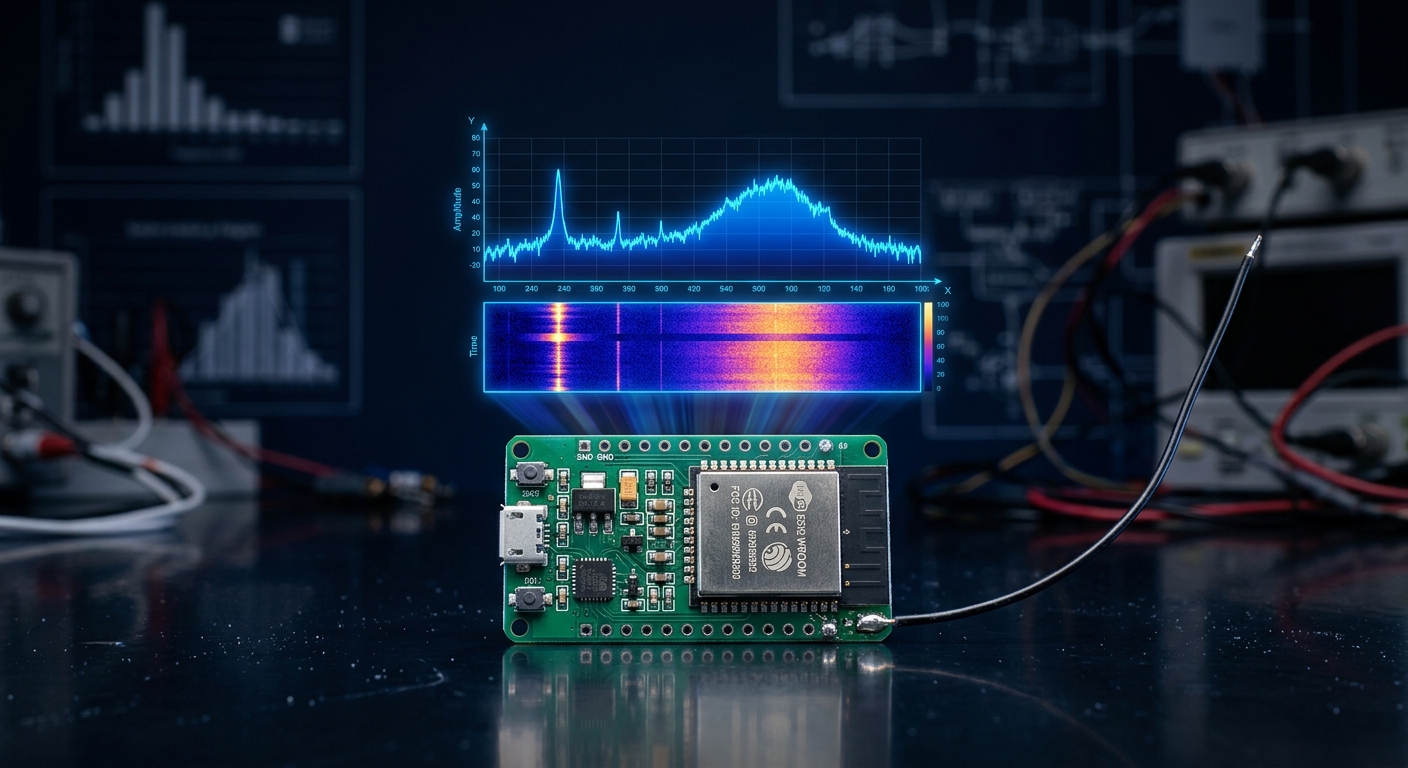
The short version
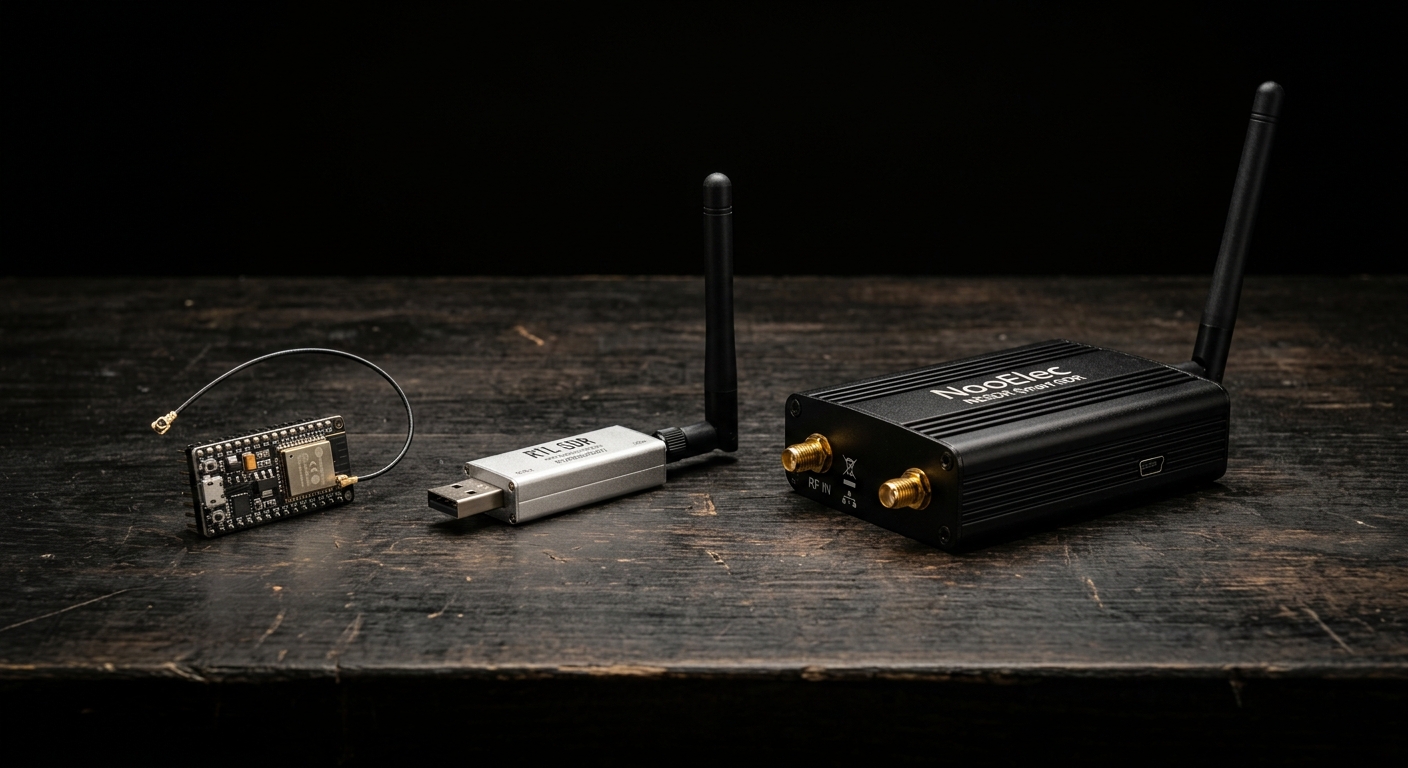
- ESP32-SDR — 2.2–2.7 GHz (plus 4.8–6.0 GHz on ESP32-C5). Transmit-capable silicon. Best: low-cost 2.4 GHz spectrum awareness and phase-coherent multi-channel arrays.
- RTL-SDR — roughly 24 MHz to 1.7 GHz, receive only, ~2.4 MSa/s usable bandwidth. Best: general-purpose listening below 2 GHz on a tiny budget.
- HackRF One — 1 MHz to 6 GHz, half-duplex transmit and receive, 20 MSa/s. Best: transmit experiments and wideband work, at a much higher price.
Comparison table
| Specification | ESP32-SDR | RTL-SDR | HackRF One |
|---|---|---|---|
| Frequency range | 2.2–2.7 GHz (4.8–6.0 GHz on ESP32-C5) | ~24 MHz – 1.766 GHz | 1 MHz – 6 GHz |
| Sample rate | Up to 80 MSa/s burst; 20–40 MSa/s continuous on ESP32-S31 | ~2.4 MSa/s | 20 MSa/s |
| Bandwidth | ~13–54 MHz analog RX | ~2.4 MHz | 20 MHz |
| Transmit | Silicon capable, not officially released | No | Yes (half-duplex) |
| Channels | Up to 8 phase-coherent channels (ESPARGOS One) | Single | Single |
| Host interface | UART, SPI, high-speed USB or Ethernet | USB 2.0 | USB 2.0 |
| Typical cost | Cost of a supported ESP32 board | ~$25–40 | ~$300–400 |
| Maturity | New, experimental tooling | Very mature ecosystem | Mature, wide software support |
Where ESP32-SDR wins
Cost per channel
This is the headline. An ESPARGOS One array gives you eight phase-coherent receive channels with angle-of-arrival capability for €350 excluding VAT. Eight coherent channels on any other platform is a five-figure budget. If your problem is direction finding, localisation or spatial sensing, nothing else is close.
Observing signals CSI cannot see
Because it works at the baseband level rather than on decoded 802.11 packets, an ESP32-SDR can look at Bluetooth, BLE, Zigbee, 802.11b and multi-stream Wi-Fi — formats that channel-state-information capture simply cannot address.
No extra hardware on your BOM
If your product already contains an ESP32, adding spectrum-awareness to a diagnostic build costs nothing in components. That is a very different proposition from asking a customer to plug in an RTL-SDR dongle.
Where it loses
- Duty cycle. On most chips the modem pushes 2,560 Mbit/s into SRAM while UART moves ~3 Mbit/s and SPI ~13.3 Mbit/s. You get bursts, not a continuous stream, and you may miss packets between windows.
- Narrow frequency coverage. 2.2–2.7 GHz only — no FM broadcast, no airband, no 433/868 MHz sensors, no sub-GHz ISM. An external mixer can down-convert those bands, but that is extra hardware and extra engineering.
- No released transmitter. The silicon can transmit and ESPARGOS One can do it phase-coherently, but the team withholds a transmit implementation because of jamming concerns. If your project needs TX, buy a HackRF.
- Young tooling. The firmware, the browser interface and the SoapySDR driver are all new. Expect experimental behaviour, sparse documentation and the occasional rough edge.
- Driver scope. SoapyESPSDR is receive-only and currently targets the ESP32-S31 specifically.
Which should you actually buy?
| If you want to… | Buy |
|---|---|
| See what is happening in 2.4 GHz, cheaply and now | Any supported ESP32 board |
| Stream continuous IQ into GNU Radio or Gqrx | ESP32-S31 Function-CoreBoard |
| Direction-find BLE, Zigbee or Wi-Fi and build a sensing demo | ESPARGOS One (€350) |
| Listen to FM, airband, 433 MHz sensors, satellites below 2 GHz | RTL-SDR |
| Transmit, replay or work across 1 MHz–6 GHz | HackRF One |
Getting started: the boards that matter
For the browser-based ESP-WebSDR demo almost any supported chip works, but keep these two paths in mind:
- Burst capture / spectrum demo: original ESP32, ESP32-C2/C3/C5/C6/C61, H2, S2 or S3, connected over its native USB port. Flash the firmware, unplug for five seconds, reconnect, open the web interface.
- Continuous IQ streaming: ESP32-S31 through its USB debug port or a UART adapter, using the Ethernet/USB profile and the SoapyESPSDR driver on a Linux host.
A practical note on boards: the quality of the RF front-end and the antenna matters more than the chip model for anything beyond casual spectrum viewing. A board with a proper u.FL connector and a decent 2.4 GHz antenna will outperform a bare module with a PCB trace antenna every time.
Limitations you should plan around
- Capture windows may drop packets between bursts — do not build a protocol-critical sniffer on top of burst mode.
- Signal quality on the streaming path is still described as experimental by the authors.
- Firmware for the ESPARGOS One array remains closed source for now, though the team is considering open-sourcing it.
- Chip support must be implemented per model — check the supported list before buying an exotic variant.
Conclusion
The honest answer in 2026 is that ESP32-SDR does not replace RTL-SDR, and certainly does not replace HackRF. It opens a third category: ultra-low-cost, multi-channel, 2.4 GHz-focused sensing. If your work involves the ISM band — and for industrial IoT and smart buildings, it usually does — this is the cheapest way to gain real visibility into it, and the only cheap way to get eight phase-coherent channels.
📞 Contact TDLOGY today for a FREE consultation!
Not sure which hardware fits your project? Tell us what you need to sense, where, and how often — we will tell you honestly whether an ESP32-SDR approach makes sense or whether you need different test equipment.
🌐 Website: tdlogy.com
📧 Email: contact@tdlogy.com
📱 Hotline: 0969.528.497
Sources: ESPARGOS — ESP-SDR, ESPARGOS/esp-sdr, SoapyESPSDR. RTL-SDR and HackRF figures are the widely published specifications for those products.

Leave a Reply